Summary
This review article explores the potential clinical applications of electrolyzed water, including its use in oral health interventions, disinfection of hospital surfaces, and decontamination of animal transport vehicles, highlighting the efficacy of electrolyzed water against various pathogens, such as porcine reproductive and respiratory syndrome virus and foot-and-mouth disease virus.
Key points
- Electrolyzed water has been shown to have antimicrobial properties and can be used for disinfection in various settings, including dental units, hospitals, and animal transport vehicles.
- Some studies have demonstrated the effectiveness of electrolyzed water in inactivating viruses, including foot-and-mouth disease virus and Newcastle disease virus.
- Electrolyzed water has also been shown to be effective in reducing the prevalence of oral opportunistic pathogens and caries risk in children.
- There is potential for the use of electrolyzed water in ensuring the safety and quality of meat and seafood products.
As a library, NLM provides access to scientific literature. Inclusion in an NLM database does not imply endorsement of, or agreement with, the contents by NLM or the National Institutes of Health. Learn more about our disclaimer. (opens in a new tab)
Microorganisms. (opens in a new tab) 2021 Jan; 9(1): 136.
Author information (opens in a new tab) Article notes (opens in a new tab) Copyright and License information (opens in a new tab) Disclaimer (opens in a new tab)
Abstract
As the situation of severe acute respiratory syndrome coronavirus type 2 (SARS-CoV-2) is still deteriorating, there has been a huge increase in the demand and use of disinfectants. Electrolyzed water (EW), as a novel broad-spectrum disinfectant and cleaner, has been widely used for several years. EW can be produced in an electrolysis chamber which contains dilute salt and tap water. It is an effective antimicrobial and antibiofilm agent, with several advantages such as on-the-spot, cheap, environmentally friendly and safe for human beings. Therefore, EW holds potential significance for high-risk settings in hospitals and other clinical facilities. EW can also be applied for wound healing, advanced tissue care, and dental clinics. The present review article highlights the latest developments and new perspectives of EW, especially in clinical fields. Furthermore, the main action modes of antibiofilm and antimicrobial will be summarized.
**Keywords: **electrolyzed water, clinical application, antimicrobial effect, wound healing, antibiofilm, oral hygiene
1. Introduction
The Center for Disease Control and Prevention (CDC) has recently reported that there is at least one person who has a healthcare-associated infection in every 31 hospital patients in any given day [1 (opens in a new tab)]. Such healthcare-associated infections (HAI) include central line-associated bloodstream infection, catheter-associated urinary tract infections, surgical site infection and ventilator-associated pneumonia [2 (opens in a new tab)]. HAIs are a major cause of morbidity and even mortality in the United States [3 (opens in a new tab)]. The healthcare environment is a primary source of pathogenic microorganisms [4 (opens in a new tab)]. Molds may be present on wet or damp surfaces or materials [5 (opens in a new tab)]. Bacteria may also be present in bathroom installations, including sink drains and ice machines. Furthermore, surgical site infections can sometimes be superficial infections involving the skin [6 (opens in a new tab),7 (opens in a new tab)]. At the same time, infections in other surgical sites could be more serious, which may involve tissues under the skin, organs, or even implanted materials [8 (opens in a new tab),9 (opens in a new tab)]. Infections also increase the length of stay, readmission rates, costs, and even mortality [10 (opens in a new tab),11 (opens in a new tab)]. Biofilms are responsible for causing 80% of human infections. The National Institutes of Health (NIH) reported that biofilms are responsible for up to 80% of human bacterial infection [12 (opens in a new tab)].
Therefore, developing effective disinfectants and antiseptics for killing pathogens and destroying the biofilm formation in the environment and human healthcare is one of the most significant steps for infection prevention and control. The medical industry has employed a number of decontamination techniques throughout the hospital and healthcare clinical field [13 (opens in a new tab),14 (opens in a new tab),15 (opens in a new tab)]. However, some of these techniques have disadvantages such as high cost, low efficacy, remaining chemical residues, and adverse effects irritation on the human skin [16 (opens in a new tab),17 (opens in a new tab)]. As an important premise for practical application, it should have high antimicrobial efficacy and no toxicity to the human body [18 (opens in a new tab)].
Electrolyzed water (EW) is a novel disinfectant and cleaner which has been widely used in the food industry for several years to ensure the sterilization of surfaces and safety of food [19 (opens in a new tab),20 (opens in a new tab),21 (opens in a new tab),22 (opens in a new tab)]. EW is produced in an electrolysis chamber which contains dilute salt and tap water without any harmful chemical addition [23 (opens in a new tab)]. EW has antimicrobial effects against a variety of microorganisms including common biofilm, viruses, bacteria, spores and fungi in chronic wounds and environmental surfaces [24 (opens in a new tab),25 (opens in a new tab),26 (opens in a new tab),27 (opens in a new tab),28 (opens in a new tab),29 (opens in a new tab)]. Currently, due to its beneficial properties (anti-infection and cell proliferative), researchers pay more attention to the application of electrolyzed water in clinical treatments including medical sterilization. The US Environmental Protection Agency (EPA) recommended the use of disinfectants with hypochlorite acid as active ingredients for the disinfection of surfaces against COVID-19 [30 (opens in a new tab)]. Furthermore, various studies have been carried out on the antimicrobial activity of EW against different illments, including diabetic foot ulcers [31 (opens in a new tab),32 (opens in a new tab)], venous ulcers in the legs [33 (opens in a new tab),34 (opens in a new tab)] or feminine hygiene [35 (opens in a new tab),36 (opens in a new tab)].
However, some studies have reported that the application of EW is limited by factors such as the corrosion of equipment which is in contact with acidic or basic EW and the ability of organics materials (proteins, lipids and so on) to shorten its shelf life [37 (opens in a new tab),38 (opens in a new tab)]. To overcome these defects, hurdle technology, which is a combination of two or more low-dose disinfection and preservatives techniques could be applied [39 (opens in a new tab)]. Therefore, EW combined with other disinfection methods could be an effective way to obtain a desirable result [40 (opens in a new tab),41 (opens in a new tab)].
The aim of this review was to introduce recent developments and provide a new perspective with EW in the clinical field. Many characteristics of electrolyzed water in this review article were introduced including the physiochemical properties, history, limitation principle, generation methodologies, and the impact of these characteristics on the sanitizing efficacy of EW. In addition, applications of EW for microbial control in the clinical field are also discussed.
2. Principles and History of EW
The development history of electrolyzed water can be traced back for more than a century [42 (opens in a new tab)]. The concept of electrolyzed water was first proposed in Russia [43 (opens in a new tab)]. However, it has been widely used for various purposes including disinfection, water regeneration and water decontamination in Japan since 1980. As time went by, its application has extended to other fields such as the food industry, agriculture, livestock management and clinical application [44 (opens in a new tab),45 (opens in a new tab),46 (opens in a new tab),47 (opens in a new tab)]. Figure 1 (opens in a new tab) illustrates the application of EW in different areas at different pH values.
Click on image to zoom (opens in a new tab)
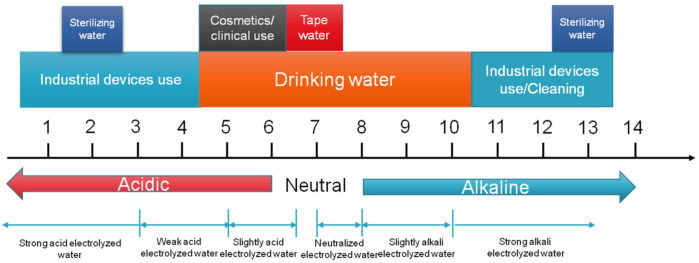
Application of electrolyzed water (EW) at different pH values in various fields.
Electrolyzed reduced water was invented in the early 19th century [48 (opens in a new tab)]. Research on electrolyzed water started in Japan around 1931 and its application and popularity to agriculture in the 1950s. In 1960, the water was applied to medical care and in 1966, electrolyzed reduced water was touted as having “healing effects” including indigestion, chronic diarrhea, antacid, abnormal gastrointestinal fermentation, and hyperacidity [49 (opens in a new tab)]. A device for the preparation of ERW was authorized for home-use by the Ministry of Health, Labor, and Welfare of Japan [50 (opens in a new tab)].
In 1994, with the support of the Ministry of Health, Labor, and Welfare of Japan, the functional water foundation was established to promote the use of electrolyzed water in society. Based on considerable scientific evidence related to the risk assessment of EW, in 2005, the Drugs, Cosmetics and Medical Instruments Act of Japan was revised and re-authorized an ERW-producing device as a home-managed medical device. In 2002, the Ministry authorized the use of hypochlorous acid water on designated food additives. Recently, in 2017, the US Food and Drug Administration (USFDA) also authorized hypochlorous acid (electrolytically generated on-site) for use on food contact surfaces (FCS) [51 (opens in a new tab)]. In addition, Chinese standardization administration published a series of criteria in 2020, related to hypochlorous acid water, which can be used for human skin, hand and mucous membrane. Table 1 (opens in a new tab) illustrates the criteria of application of EW in different countries.
Table 1
Criteria of EW in different countries.
Open in a separate window (opens in a new tab)
3. Systems for Generation of Electrolyzed Water
Electrolyzed water (EW) is produced in an electrolysis chamber which contains hydrogen chloride (HCl) solution or dilute salt (NaCl) [52 (opens in a new tab)]. According to the different devices, electrolyte and electrolysis conditions, EW can be classified into the following categories: acidic electrolyzed water, neutral electrolyzed water and alkali electrolyzed water [53 (opens in a new tab)]. The characteristic of EW is shown in Table 2 (opens in a new tab). The application of EW can be roughly divided into alkali water for drinking and electrolytic water for cleaning, sterilization, and disinfection [49 (opens in a new tab),54 (opens in a new tab),55 (opens in a new tab),56 (opens in a new tab)].
Table 2
Characteristics and parameters of various electrolyzed waters.
Open in a separate window (opens in a new tab)
These solutions are produced by the electrolysis of dilute salt (NaCl) passing through two or three cell electrolyzers with the anode and cathode separated by a diaphragm. It can produce two types of water simultaneously. Acidic electrolyzed water (AEW), with a pH of 2 to 3, available chlorine concentration (ACC) of 10 to 90, and oxidation–reduction potential (ORP) >1100 Mv, is produced at the anode side [23 (opens in a new tab)]. At the same time, basic electrolyzed water (BEW) with a pH of 10 to 13, and ORP from −800 to −900 Mv is generated at the cathode side. Nowadays, there are some novel forms of electrolyzed water such as slightly acid electrolyzed water (SAEW), weak acid electrolyzed water (WAEW) and neutral electrolyzed water (NEW) [57 (opens in a new tab),58 (opens in a new tab),59 (opens in a new tab)]. SAEW is very popular in Japan, China and Korea [60 (opens in a new tab),61 (opens in a new tab),62 (opens in a new tab)]. SAEW (pH of 5.5–6.5, ACC of 10–80 ppm and ORP of 800–900 Mv), and NEW (pH of 7–8 and ORP of 750–900 Mv) are produced by using single-cell chambers. SAEW is produced by the electrolysis of HCl alone or combined with NaCl in a single-cell unit (without diaphragm) [63 (opens in a new tab)]. It is expected that the SAEW will not lose its superior features after mixing due to the unipolar reaction in the process of electrolysis. In addition to the above method, NEW can also be produced by a mixture of the anodic solution with OH− ions [64 (opens in a new tab)]. The details are shown in Figure 2 (opens in a new tab). EW can also be stored in containers of special materials or converted into ice cubes for future use [65 (opens in a new tab)].
Generation of electrolyzed water. (A): alkaline electrolyzed water and acidic electrolyzed water; (B): slightly acidic electrolyzed water. Created with BioRender.com.
4. Factors Influencing Decontamination Efficacy of Electrolyzed Water
4.1. Direct Factors
The concentration of chlorine (Cl2, OCl−, and HOCl), ORP, and pH directly play an important role in the antimicrobial efficacy of EW (shown in the Figure 3 (opens in a new tab)). HOCl is the most effective inactivation compound in the chlorine group [66 (opens in a new tab)]. They found that the inactivation efficacy of HOCl was 80-fold higher than that of an equivalent concentration of OCl− when the pH value of the solution was from 5.0 to 6.5. Ding et al. reported that SAEW treatment on S. aureus for 1 min reduced 5.8 log CFU/mL, but sodium hypochlorite (NaClO) decreased by the bacteria by 3.26 log CFU/mL [67 (opens in a new tab)]. This might be explained by considering that the electrical properties of the HOCl and OCl− are different. HOCl is neutral, whereas the hypochlorite ion (OCl−) and bacterial membrane are both negative [68 (opens in a new tab)]. Therefore, HOCl can more easily penetrate target cells to exert strong bactericidal effects based on Coulomb’s law. However, the fraction of chlorine species depends on the pH of the solution [69 (opens in a new tab)]. HOCl is a weak acid with a pKa of about 7.46 [70 (opens in a new tab)]. Therefore, if the pH value is low (pH < 4), it is possible to form Cl2. When the pH value is above 7.5, HOCl is decomposed into hydrogen ion (H+) and hypochlorite ion (OCl−) in the reversible reaction [70 (opens in a new tab)]. HOCl, as one of the reactive oxygen species (ROS), infiltrates the membranes of bacteria cells and kills pathogens through chlorination or oxidation, which destructs the key metabolic frameworks [71 (opens in a new tab)]. In addition, there are a few reports of the inactivation action being mainly affected by the ORP of EW. They reported that high ORP may result in modifying the metabolic flux and ATP production [72 (opens in a new tab)]. Liao et al. studied the inactivation mechanism of ORP in EOW. The results showed that EOW with higher ORP had a higher efficiency of the inactivation of E. coli O157:H7 by damaging the outer membrane and inner membrane, thus releasing the intracellular component [73 (opens in a new tab)].
Factors affecting the decontamination efficacy of electrolyzed water. ACC: available chlorine concentration; ORP: oxidation–reduction potential.
4.2. Indirect Factors
The concentration of electrolyte, water flow rate and water source (hardness) indirectly influence the effectiveness of EW(shown in the Figure 3 (opens in a new tab)). However, the above factors are linearly correlated to the amount of HOCl and ORP in the process of electrolysis and ultimately reduce or increase the decontamination efficacy of EW (the properties of EW).
Kim et al. [26 (opens in a new tab)] examined the effects of the water hardness of SAEW in inactivating Staphylococcus aureus, Salmonella enterica serovar Typhimurium, Escherichia coli, and Bacillus cereus spores. The results showed that the ACC of SAEW produced by tap water (hardness = 29 ppm) is better than that of underground water (hardness = 12 ppm). The hardness of water is mainly dependent on the content of calcium and magnesium [74 (opens in a new tab)]. There is a positive correlation between salinity and conductivity. In addition, electrical conductivity and the total chlorine concentration of the electrolyzed oxidizing water increased with the increasing salt concentration. When the concentration of salt (KCl) was increased from 2.0 M to 3.0 M, the ACC increased from 56.5 to 65.5 ppm in the same time [26 (opens in a new tab)].
Moreover, the water flow rate affects the ACC. Hsu et al. reported that the total ACC and ORP of electrolyzed oxidizing water was significantly decreased when water flow rate and salt concentration increased in the feed solution [75 (opens in a new tab)]. The reasons are maybe that the higher flow rate leads to less residence of ions in the electrolysis cell per unit time, chloride ions and sodium ions could not be sufficiently electrolyzed and moved to the anode side [74 (opens in a new tab)]. Therefore, more sodium, chloride ions and less HOCl remained in the feed water.
5. The Advantages and Disadvantages of Electrolyzed Water
There are many advantages of EW over its toxic counterparts (physical, chemical and biological technology) in different areas such as agriculture, food hygiene, medical field and even in human surface disinfection. The advantages of electrolyzed water can be easily enumerated.
First, EW has been proposed as an environmentally friendly alternative to physical and chemical methods, which do not contain undesirable toxic contaminants [76 (opens in a new tab)]. As previously mentioned above, EW is only produced from NaCl and tap water and reverts to regular water after use [77 (opens in a new tab)]. Second, EW has a broad-spectrum inactivation ability and rapid antibacterial activity, which possesses nonselective properties [78 (opens in a new tab),79 (opens in a new tab)]. HOCl was produced by an enzyme called myeloperoxidase, which uses hydrogen peroxide (H2O2) in our body as a substrate to react with neutrophils. [80 (opens in a new tab)]. HOCl is a naturally occurring molecule and has strong bactericidal ability to serve as a reliable defense system [78 (opens in a new tab)]. Medina et al. reported that artificially contaminated eggs with Salmonella or E. coli reduced >1.45 Log10 CFU/egg and >6.39 Log10 CFU/egg, respectively, after 30 s treatment of NEW [72 (opens in a new tab)]. Third, EW-producing machines have the ability for on-site generation at the location of intended use inexpensively [23 (opens in a new tab)]. The volume of 1 L of EW can be made in 8 min and the process can be repeated multiple times a day [19 (opens in a new tab)]. Therefore, it can prevent chlorination problems during handling, storage, and transport. Additionally, the use of AEW, alkaline electrolyzed water (AlEW), NEW, and SAEW do not cause negative organoleptic changes in food [49 (opens in a new tab),81 (opens in a new tab),82 (opens in a new tab)]. Finally, NEW and SAEW have a neutral pH and are safe, with no irritation on mucous membrane and skin [83 (opens in a new tab)].
When tackling the disadvantages and advantages of EW, we also need to point out the adverse impact of this novel technology. First, EW is a sanitizer produced from tap water with sodium chloride (NaCl) without the addition of harmful chemicals [84 (opens in a new tab)]. However, it still contains chemical compounds. The USFDA published a regulation that when EW is used to process fruits, vegetables, ready-to-eat meats, fish and seafood products intended to be consumed raw, the treatment will be followed by either a 10 min drain step or a potable water rinse to remove residues [51 (opens in a new tab)]. In addition, the Ministry of Health, Labour and Welfare (Japan) issued an act to remove HOCl before it becomes the final product. Second, the concentration of chlorine decreases over time, and loses its antimicrobial potential quickly [85 (opens in a new tab)]. Third, the degradation of synthetic resins and metal corrosion can be caused by high ORP or the free chlorine content during the use of AEW [22 (opens in a new tab),86 (opens in a new tab)].
6. Disinfection Mechanisms of EW
In order to produce the safe and effective use of disinfectants, numerous disinfection methods have been studied and reported over the years. Many researchers have fully studied the mechanism of traditional disinfection methods such as physical treatments (heat and irradiation etc.) and chemical disinfectants (hydrogen peroxide and chlorine dioxide etc.) [87 (opens in a new tab)]. However, the exact mechanisms underlying microbial inactivation by EW have not been fully elucidated. It is well known that chlorine (Cl2, −OCl, and HOCl) plays an important role in the antimicrobial efficacy of electrolyzed water [88 (opens in a new tab)]. HOCl can penetrate the lipid bilayer of the cell membrane by passive diffusion due to its molecular size (which is equivalent to water (H2O)) and its electrical neutrality [89 (opens in a new tab)]. In addition, HOCl is a powerful oxidizing agent, which denatures and aggregates proteins [90 (opens in a new tab)]. These may be the reason for the excellent germicidal activity of HOCl. Ding et al. found that SAEW disrupted cell membrane permeability by damaging membrane proteins, entering the cells and causing the agglutination of cellular inclusions in S. aureus [67 (opens in a new tab)]. Furthermore, Tang et al. reported that EOW decreased the activity of TCC-dehydrogenase, intensified the permeability of the membrane, increased the conductivity of suspension, and resulted in the leakage of K+, protein and DNA, which indicated that the cell wall and membrane were damaged [91 (opens in a new tab)]. However, OCl– cannot penetrate the microbial cell and microbial membrane because there is a lipid bilayer in the plasma membrane (hydrophobic layer) [92 (opens in a new tab)]. OCl− only exhibits an oxidizing action from outside the cell, which would inactivate functional proteins localized in the plasma membrane [93 (opens in a new tab)]. In addition to the chlorine family, other compounds (reactive oxygen species) can be produced in the process of electrolysis, which contributes to the antimicrobial efficiency [94 (opens in a new tab)]. Figure 4 (opens in a new tab) shows the mechanism of HOCl and OCl– reaction on pathogens. The exact pattern of EW on microbial cells is still unclear and requires more investigations to clarify in the future.
Model representing the mechanism of electrolyzed water. Created with BioRender.com.
7. Use of EW for Clinical Application
Recently, the Ministry of Health of the People’s Republic of China released three Chinese standards for materials and restricted substances in disinfectants, general requirements for hand disinfectants and general requirements for the disinfectants of mucous membrane in April 2020 [95 (opens in a new tab),96 (opens in a new tab)]. In short, EW can not only be used for disinfecting medical instruments, clinical environments and object surfaces, but also disinfecting hands, skin, and mucous membranes. In addition, the US Environmental Protection Agency has recommended many disinfectants for COVID-19, including HOCl. Currently, there are a variety of EW-based disinfection products on the market. The approved core formula is HOCl, which can remain stable for up to twelve months without cytotoxicity [97 (opens in a new tab)]. Importantly, its pH neutralization can enhance therapeutic activity, stability and skin tolerability. Many patents including the use of EW application for advanced tissue care, dermatology and dental care are available [98 (opens in a new tab),99 (opens in a new tab),100 (opens in a new tab)]. The application of EW in the clinical field was shown in Table 3 (opens in a new tab).
Table 3
Applications of EW against various microorganisms in clinical infections.
Open in a separate window (opens in a new tab)
7.1. Wound Care
A topical antibacterial agent, which can reduce the bacterial biological load of the wound without impairing the healing ability, is an imperative condition for therapy [124 (opens in a new tab)]. Wound healing is a complex process including multiple stages: hemostasis, inflammation, proliferation and tissue remodeling [125 (opens in a new tab)]. The timely resolution of each healing process is critical for promoting healing and avoiding excess scar formation. Currently, the treatments for impaired wound healing focus mainly on the optimization of controllable factors including the clearance of infections, mechanical protection, and nutritional support [126 (opens in a new tab)]. Wound care should also minimize scarring and inflammation. Recently, EW with antimicrobial properties has been utilized as part of cell proliferation, anti-infection and anti-biofilm therapies in a wound healing agent (shown in the Figure 5 (opens in a new tab)) [114 (opens in a new tab),127 (opens in a new tab)]. Ben et al. found that with the application of MicroSafe® as an instillation fluid with a novel foam dressing and negative pressure wound therapy for the patient, the wound bed showed dramatic improvement after three days of treatment [128 (opens in a new tab)]. Sasai et al. also studied the potential use of AEW for patients with atopic dermatitis. Their results also revealed that the treatment with 3 min spraying and after 1 week of skin reduced the Staphylococcus aureus count by about 3.80 log/cm2 reduction without any detrimental effect [108 (opens in a new tab)]. Scientists reported that electrolyzed water has an effect on skin wound healing. Tiroda et al. reported that nine patients (23%) using superoxidized solution improved by at least 75% in the reduction in lesions [129 (opens in a new tab)]. Additionally, biofilm formation causes prolonged wound infections due to the dense biofilm structure, differential gene regulation to combat stress, and the production of extracellular polymeric substances [112 (opens in a new tab)]. HOCl (active compound) is able to increase oxygenation (TcPO2) in wounds while breaking biofilms, which is an important key differentiator from other products [130 (opens in a new tab)].
Model representing the mechanism of electrolyzed water on wounds. Created with BioRender.com.
7.2. Hand Sanitizer
Hand sanitization is the most important but simple way to remove germs, prevent the spread of germs to others and avoiding illness [131 (opens in a new tab)]. For EW-based hand sanitizers sold in China, the concentration of ACC usually ranges from 30 to 150 ppm, which is effective against viruses and bacteria. In addition to using EW as a liquid-based disinfectant, EW in fog form also show an antibacterial effect against numerous types of bacteria [123 (opens in a new tab)]. Pathogens related to hand hygiene and healthcare include Escherichia coli, Pseudomonas aeruginosa, Staphylococcus aureus, Enterococcus hirae, Candida albicans. Sipahi et al. reported the inactivation effect of StAEW, SAEW, mixed electrolyzed water (MEW) and catholyte (CEW) on Escherichia coli, Pseudomonas aeruginosa, Staphylococcus aureus, Enterococcus hirae, Candida albicans. They found that StAEW, SAEW, and MEW reduced the agents significantly. StAEW was especially effective against test microorganism (Pseudomonas aeruginosa, Enterococcus hirae and Candida albicans) populations, which all decreased by 100% in 1 min [132 (opens in a new tab)]. HOCl (~95%) is the main compound of the active chlorine family in SAEW, which is considered to be the cause of microbial inactivation [133 (opens in a new tab)]. SAEW with a neutralized pH has attracted more and more attention as an antibacterial solution. SAEW may be a promising novel clinical disinfectant that may be considered as an alternative to traditional alcohol-based hand sanitizer [40 (opens in a new tab),134 (opens in a new tab)].
7.3. Oral Hygiene
The dental community has long sought for appropriate antibacterial products to try to control and prevent the proliferation of oral microbiome, especially during dental surgery when host barrier function is often impaired. Microorganisms related to oral hygiene include Streptococcus salivarius, Staphylococcus aureus, Lactobacillus casei, Aggregatibacter actinomycetemcomitans [135 (opens in a new tab),136 (opens in a new tab),137 (opens in a new tab),138 (opens in a new tab)]. They found that AEW significantly inhibited the above bacterial growth for 30 secs without negative cytotoxic effects [115 (opens in a new tab)]. Hsieh et al. studied the electrolyzed oxidizing (EO) water as a mouthwash against Streptococcus mutans. The results revealed that EOW (125 ppm) showed antimicrobial effectiveness (>99.9%) against S. mutans after soaking treatment for 3 min [139 (opens in a new tab)]. The contamination of the dental water unit line is one of the major causes of oral infection [140 (opens in a new tab),141 (opens in a new tab)]. A study on the treatment of the oral comprehensive treatment station containing mouthwash and pipe water in hospitals by SAEW treatment has been reported. The qualified rate of water sanitation quality in the water treatment channel increased from 8.85 to 49.15 % [120 (opens in a new tab)]. Nakano et al. also reported that there was little negative effects concerning the use of SAEW for the water line of dental units during seven years of clinical trials [142 (opens in a new tab)].
7.4. Environmental Decontamination
Experts generally agree that the daily careful cleaning and/or disinfection of environmental surfaces is an essential way to prevent hospital infection [143 (opens in a new tab)]. The potential use of EW in the disinfection of inanimate surfaces have been evaluated experimentally [118 (opens in a new tab),144 (opens in a new tab),145 (opens in a new tab)]. Meakin et al. revealed that EW exerts a more effective bacterial kill on door hand, lavatory and seat compared to quaternary ammonium disinfectant [146 (opens in a new tab)].
8. Future Perspectives
The COVID-19 pandemic has placed an immense burden on healthcare systems and economies around the world. At the time of the study, there was no effective approved vaccine and drug against SARS-CoV-2 available. With increasing hygiene and safety challenges, electrolyzed water holds a potential significance for clinical fields since disinfecting is a critical step during cutting off route transmission [147 (opens in a new tab)]. Researchers reported that EW was effective at inactivating SARS-CoV-2, porcine reproductive and respiratory syndrome virus (PRRSV), pseudorabies virus (PRV), foot-and-mouth disease virus (FMDV), Newcastle disease virus [24 (opens in a new tab),148 (opens in a new tab),149 (opens in a new tab),150 (opens in a new tab)]. Microorganisms can spread from their source to new hosts through direct or indirect contact, in the air, or through vectors [151 (opens in a new tab)].
All the EW exhibits strong antimicrobial efficacy in different fields such as food and hard surface as well as agriculture, medical, and dentistry without irritation [144 (opens in a new tab)]. EW has been approved by the Japanese, US, and Chinese regulations as a perfect substitute for harmful chemicals and as a novel sustainable and eco-friendly solution for use in the hospitals and at home. In recent years, a continuous growth trend of commercialization of EW has been observed throughout the world. Given the importance of EW, many companies are scrambling to establish and start producing EW products such as Clortech®, Avenova®, Ecasol™, MicroSafe® and Microcyn®. These companies claim to produce EW-based products that have a remarkable antimicrobial effect, while being safe to use around the nose, mouth, and eyes. However, the limitation of EW is that it has not been widely studied, notably for efficacy against multidrug- and extensively drug-resistant Gram-negative bacteria according with World Health Organization priority pathogens list.
SAEW is the most studied EW and has shown its pH-neutral properties. HOCl was found to be nonirritating and non-sensitizing in various animal safety models. The composition of SAEW solution is relatively simple, and once it becomes exposed to the air, the active ingredients will decompose and its sanitizing efficacy drops [152 (opens in a new tab)]. Researchers are constantly exploring the mechanism of the EW antimicrobial effect and developing an advanced and dynamic EW production system that is capable of overcoming all the current limitations. In the near future, this powerful lack of antimicrobial resistance and safety makes SAEW a particularly attractive option for surgical wound site antimicrobial activity, especially in cosmetic, eye care and private women’s care.
9. Conclusions
EW is an effective disinfectant, with several advantages such as on-the-spot, cheap, environmentally friendly and safety production. Nowadays, with the development of a novel popular type of SAEW, some limitations have been resolved. It has been reported that SAEW does not irritate the hands, skin, and mucous membranes, and causes no safety issues from Cl2 off-gassing. It recently emerged with great potential for clinical applications. However, the antimicrobial effect of EW is influenced by the presence of organic matter, water pollutants, and the hardness of the product. Therefore, a dynamic and advanced EW production system or the hurdle technology of combing with multiple technologies-based EW that are able to overcome currently limitations. These may expand the use of EW in clinical applications.
Author Contributions
P.Y.: writing, original draft preparation, E.B.-M.D.: revision and formatting, D.-H.O.: supervision, conceptualization. All authors have read and agreed to the published version of the manuscript.
Funding
This work was supported by a grant from the Brain Korea (BK) 21 Plus Project (Grant No. 22A20153713433) Funded by the Korean Government, Republic of Korea.
Conflicts of Interest
The authors declare no conflict of interest.
Footnotes
Publisher’s Note: MDPI stays neutral with regard to jurisdictional claims in published maps and institutional affiliations.
References
Yeshambel A., Endalamaw A., Belay D.M., Mekonen D.K., Birhan B.M., Bayih W.A. Healthcare-associated infection and its determinants in Ethiopia: A systematic review and meta-analysis. PLoS ONE. 2020;15:e0241073. doi: 10.1371/journal.pone.0241073. [PMC free article (opens in a new tab)] [PubMed (opens in a new tab)] [CrossRef (opens in a new tab)] [Google Scholar (opens in a new tab)]
Weiner-Lastinger L.M., Abner S., Edwards J.R., Kallen A.J., Karlsson M., Magill S.S., Pollock D., See I., Soe M.M., Walters M.S., et al. Antimicrobial-resistant pathogens associated with adult healthcare-associated infections: Summary of data reported to the National Healthcare Safety Network, 2015–2017. Infect. Control Hosp. Epidemiol. 2019;41:1–18. doi: 10.1017/ice.2019.296. [PMC free article (opens in a new tab)] [PubMed (opens in a new tab)] [CrossRef (opens in a new tab)] [Google Scholar (opens in a new tab)]
Savetamal A. Infection in Elderly Burn Patients: What Do We Know? Surg. Infect. 2020;21 doi: 10.1089/sur.2020.322. [PubMed (opens in a new tab)] [CrossRef (opens in a new tab)] [Google Scholar (opens in a new tab)]
Chyderiotis S., Legeay C., Verjat-Trannoy D., Le Gallou F., Astagneau P., Lepelletier D. New insights on antimi-crobial efficacy of copper surfaces in the healthcare environment: A systematic review. Clin. Microbiol. Infec. 2018;24:1130–1138. doi: 10.1016/j.cmi.2018.03.034. [PubMed (opens in a new tab)] [CrossRef (opens in a new tab)] [Google Scholar (opens in a new tab)]
Habibi A., Safaiefarahani B. Indoor Damp Surfaces Harbor Molds with Clinical Significance. Curr. Med. Mycol. 2018;4:1–9. doi: 10.18502/cmm.4.3.169. [PMC free article (opens in a new tab)] [PubMed (opens in a new tab)] [CrossRef (opens in a new tab)] [Google Scholar (opens in a new tab)]
Edmiston C.E., McBain A.J., Kiernan M., Leaper D.J. A narrative review of microbial biofilm in postoperative surgical site infections: Clinical presentation and treatment. J. Wound Care. 2016;25:693–702. doi: 10.12968/jowc.2016.25.12.693. [PubMed (opens in a new tab)] [CrossRef (opens in a new tab)] [Google Scholar (opens in a new tab)]
Iskandar K., Sartelli M., Tabbal M., Ansaloni L., Baiocchi G.L., Catena F., Coccolini F., Haque M., Labricciosa F.M., Moghabghab A., et al. Highlighting the gaps in quantifying the economic burden of surgical site infections associated with antimicrobial-resistant bacteria. World J. Emerg. Surg. 2019;14:1–14. doi: 10.1186/s13017-019-0266-x. [PMC free article (opens in a new tab)] [PubMed (opens in a new tab)] [CrossRef (opens in a new tab)] [Google Scholar (opens in a new tab)]
Stevens D.L. Treatments for skin and soft-tissue and surgical site infections due to MDR Gram-positive bacteria. J. Infect. 2009;59:S32–S39. doi: 10.1016/S0163-4453(09)60006-2. [PubMed (opens in a new tab)] [CrossRef (opens in a new tab)] [Google Scholar (opens in a new tab)]
Gomila A., Carratalà J., Badia J.M., Camprubí D., Piriz M., Shaw E., Diaz-Brito V., Espejo E., Nicolas C., Brugués M. Preoperative oral antibiotic prophylaxis reduces Pseudomonas aeruginosa surgical site infections after elective colorectal surgery: A multicenter prospective cohort study. BMC Infect. Dis. 2018;18:507. doi: 10.1186/s12879-018-3413-1. [PMC free article (opens in a new tab)] [PubMed (opens in a new tab)] [CrossRef (opens in a new tab)] [Google Scholar (opens in a new tab)]
Lim S.L., Ong K.C.B., Chan Y.H., Loke W.C., Ferguson M., Daniels L. Malnutrition and its impact on cost of hos-pitalization, length of stay, readmission and 3-year mortality. Clin. Nutr. 2012;31:345–350. doi: 10.1016/j.clnu.2011.11.001. [PubMed (opens in a new tab)] [CrossRef (opens in a new tab)] [Google Scholar (opens in a new tab)]
Lingsma H.F., Bottle A., Middleton S., Kievit J., Steyerberg E.W., Marang-Van De Mheen P.J. Evaluation of hospital outcomes: The relation between length-of-stay, readmission, and mortality in a large international administrative database. BMC Health Serv. Res. 2018;18:116. doi: 10.1186/s12913-018-2916-1. [PMC free article (opens in a new tab)] [PubMed (opens in a new tab)] [CrossRef (opens in a new tab)] [Google Scholar (opens in a new tab)]
Jamal M., Ahmad W., Andleeb S., Jalil F., Imran M., Nawaz M.A., Hussain T., Ali M., Rafiq M., Kamil M.A. Bacterial biofilm and associated infections. J. Chin. Med. Assoc. 2018;81:7–11. doi: 10.1016/j.jcma.2017.07.012. [PubMed (opens in a new tab)] [CrossRef (opens in a new tab)] [Google Scholar (opens in a new tab)]
Song X., Vossebein L., Zille A. Efficacy of disinfectant-impregnated wipes used for surface disinfection in hospitals: A review. Antimicrob. Resist. Infect. Control. 2019;8:1–14. doi: 10.1186/s13756-019-0595-2. [PMC free article (opens in a new tab)] [PubMed (opens in a new tab)] [CrossRef (opens in a new tab)] [Google Scholar (opens in a new tab)]
Klemeš J.J., Fan Y.V., Jiang P. The energy and environmental footprints of COVID-19 fighting measures-PPE, dis-infection, supply chains. Energy. 2020;211:118701. doi: 10.1016/j.energy.2020.118701. [PMC free article (opens in a new tab)] [PubMed (opens in a new tab)] [CrossRef (opens in a new tab)] [Google Scholar (opens in a new tab)]
Wang J., Shen J., Ye D., Yan X., Zhang Y., Yang W., Li X., Wang J., Zhang L., Pan L. Disinfection technology of hospital wastes and wastewater: Suggestions for disinfection strategy during coronavirus Disease 2019 (COVID-19) pandemic in China. Environ. Pollut. 2020;262:114665. doi: 10.1016/j.envpol.2020.114665. [PMC free article (opens in a new tab)] [PubMed (opens in a new tab)] [CrossRef (opens in a new tab)] [Google Scholar (opens in a new tab)]
Stoica M. Sustainable Food Systems from Agriculture to Industry. Elsevier; Amsterdam, The Netherlands: 2018. Sustainable Sanitation in the Food Industry; pp. 309–339. [Google Scholar (opens in a new tab)]
Sharma A., Das P., Buschmann M., Gilbert J.A. The Future of Microbiome-Based Therapeutics in Clinical Applications. Clin. Pharmacol. Ther. 2020;107:123–128. doi: 10.1002/cpt.1677. [PubMed (opens in a new tab)] [CrossRef (opens in a new tab)] [Google Scholar (opens in a new tab)]
Goh C.F., Ming L.C., Wong L.C. Dermatologic reactions to disinfectant use during the COVID-19 pandemic. Clin. Dermatol. 2020 doi: 10.1016/j.clindermatol.2020.09.005. [CrossRef (opens in a new tab)] [Google Scholar (opens in a new tab)]
Rahman S., Khan I., Oh D.-H. Electrolyzed Water as a Novel Sanitizer in the Food Industry: Current Trends and Future Perspectives. Compr. Rev. Food Sci. Food Saf. 2016;15:471–490. doi: 10.1111/1541-4337.12200. [PubMed (opens in a new tab)] [CrossRef (opens in a new tab)] [Google Scholar (opens in a new tab)]
Arya R., Bryant M., Degala H.L., Mahapatra A.K., Kannan G. Effectiveness of a low-cost household electrolyzed water generator in reducing the populations of Escherichia coli K12 on inoculated beef, chevon, and pork surfaces. J. Food Process. Preserv. 2018;42:e13636. doi: 10.1111/jfpp.13636. [CrossRef (opens in a new tab)] [Google Scholar (opens in a new tab)]
Veasey S., Muriana P.M. Evaluation of electrolytically-generated hypochlorous acid (‘electrolyzed water’) for sanitation of meat and meat-contact surfaces. Foods. 2016;5:42. doi: 10.3390/foods5020042. [PMC free article (opens in a new tab)] [PubMed (opens in a new tab)] [CrossRef (opens in a new tab)] [Google Scholar (opens in a new tab)]
Graça A., Santo D., Quintas C., Nunes C. Growth of Escherichia coli, Salmonella enterica and Listeria spp., and their inactivation using ultraviolet energy and electrolyzed water, on ‘Rocha’ fresh-cut pears. Food Control. 2017;77:41–49. doi: 10.1016/j.foodcont.2017.01.017. [CrossRef (opens in a new tab)] [Google Scholar (opens in a new tab)]
Xuan X., Ling J. Electrolyzed Water in Food: Fundamentals and Applications. Springer Science and Business Media LLC; Cham, Switzerland: 2019. Generation of Electrolyzed Water; pp. 1–16. [Google Scholar (opens in a new tab)]
Takeda Y., Uchiumi H., Matsuda S., Ogawa H. Acidic electrolyzed water potently inactivates SARS-CoV-2 de-pending on the amount of free available chlorine contacting with the virus. Biochem. Bioph. Res. Commun. 2020;530:1–3. doi: 10.1016/j.bbrc.2020.07.029. [PMC free article (opens in a new tab)] [PubMed (opens in a new tab)] [CrossRef (opens in a new tab)] [Google Scholar (opens in a new tab)]
Izumi H., Inoue A. Viability of sublethally injured coliform bacteria on fresh-cut cabbage stored in high CO2 atmospheres following rinsing with electrolyzed water. Int. J. Food Microbiol. 2018;266:207–212. doi: 10.1016/j.ijfoodmicro.2017.11.028. [PubMed (opens in a new tab)] [CrossRef (opens in a new tab)] [Google Scholar (opens in a new tab)]
Hyun-Ji K., Tango C.N., Ramachandran C., Deog-Hwan O. Sanitization Efficacy of Slightly Acidic Electrolyzed Water against pure cultures of Escherichia coli, Salmonella enterica, Typhimurium, Staphylococcus aureus and Bacillus cereus spores, in Comparison with Different Water Hardness. Sci. Rep. 2019;9:1–14. [PMC free article (opens in a new tab)] [PubMed (opens in a new tab)] [Google Scholar (opens in a new tab)]
Lemos J.G., Stefanello A., Bernardi A.O., Garcia M.V., Magrini L.N., Cichoski A.J., Wagner R., Copetti M.V. Antifungal efficacy of sanitizers and electrolyzed waters against toxigenic Aspergillus. Food Res. Int. 2020;137:109451. doi: 10.1016/j.foodres.2020.109451. [PubMed (opens in a new tab)] [CrossRef (opens in a new tab)] [Google Scholar (opens in a new tab)]
Salisbury A.-M., Percival S.L. Neurotransmitter Interactions and Cognitive Function. Springer Science and Business Media LLC; Cham, Switzerland: 2018. The Efficacy of an Electrolysed Water Formulation on Biofilms; pp. 1–8. [PubMed (opens in a new tab)] [Google Scholar (opens in a new tab)]
Eftekharizadeh F., Dehnavieh R., Hekmat S.N., Mehrolhassani M.H. Health technology assessment on super oxidized water for treatment of chronic wounds. Med. J. Islamic Repub. Iran. 2016;30:384. [PMC free article (opens in a new tab)] [PubMed (opens in a new tab)] [Google Scholar (opens in a new tab)]
Samara F., Badran R., Dalibalta S. Are Disinfectants for the Prevention and Control of COVID-19 Safe? Health Secur. 2020;18:496–498. doi: 10.1089/hs.2020.0104. [PubMed (opens in a new tab)] [CrossRef (opens in a new tab)] [Google Scholar (opens in a new tab)]
Supardi E., Yusuf S., Massi M.N., Haeruddin H. Evaluation of different type of electrolyzed water against bacterial colonization of diabetic foot ulcers: Study in vitro. Med. Clínica Práctica. 2020;3:100090. doi: 10.1016/j.mcpsp.2020.100090. [CrossRef (opens in a new tab)] [Google Scholar (opens in a new tab)]
Chittoria R.K., Yootla M., Sampatrao L., Raman S.V. The role of super oxidized solution in the management of diabetic foot ulcer: Our experience. Nepal Med. Coll. J. 2007;9:125–128. [PubMed (opens in a new tab)] [Google Scholar (opens in a new tab)]
Bongiovanni C.M. Effects of Hypochlorous Acid Solutions on Venous Leg Ulcers (VLU): Experience With 1249 VLUs in 897 Patients. J. Am. Coll. Clin. Wound Spéc. 2016;6:32–37. doi: 10.1016/j.jccw.2016.01.001. [PMC free article (opens in a new tab)] [PubMed (opens in a new tab)] [CrossRef (opens in a new tab)] [Google Scholar (opens in a new tab)]
Thekdi P.I., Bathla V., Koradi P., Jhala D., Patel D. A study on newer dressing materials versus conventional dressing materials in ulcer healing. Int. Surg. J. 2016;3:108–112. doi: 10.18203/2349-2902.isj20151491. [CrossRef (opens in a new tab)] [Google Scholar (opens in a new tab)]
Hopkins J. Electrolyzed water treatment for feminine hygiene. US20060275502A1. Google Patents. 2006 Dec 7;
Morris C.D., Stone J.K. Method for remediating mold and mildew using acidic electrolyzed water. 7445800. U.S. Patent. 2008 Nov 4;
Jo H.-Y., Tango C.N., Oh D.-H. Influence of different organic materials on chlorine concentration and sanitization of slightly acidic electrolyzed water. LWT. 2018;92:187–194. doi: 10.1016/j.lwt.2018.02.028. [CrossRef (opens in a new tab)] [Google Scholar (opens in a new tab)]
Xuan X., Wang M., Ahn J., Ma Y., Chen S., Ye X., Liu D., Ding T. Storage Stability of Slightly Acidic Electrolyzed Water and Circulating Electrolyzed Water and Their Property Changes after Application. J. Food Sci. 2016;81:E610–E617. doi: 10.1111/1750-3841.13230. [PubMed (opens in a new tab)] [CrossRef (opens in a new tab)] [Google Scholar (opens in a new tab)]
Khan I., Tango C.N., Miskeen S., Lee B.H., Oh D.-H. Hurdle technology: A novel approach for enhanced food quality and safety-A review. Food Control. 2017;73:1426–1444. doi: 10.1016/j.foodcont.2016.11.010. [CrossRef (opens in a new tab)] [Google Scholar (opens in a new tab)]
Almås G.H. Acetic acid and hypochlorous acid compositions for treatment of skin trauma. Application 15/852603. U.S. Patent. 2018
Almås G.H. Compositions and methods for treating biofilms without inducing antimicrobial resistance. Application 16/672393. U.S. Patent. 2020
Oh D.-H., Khan I., Tango C.N. Electrolyzed Water in Food: Fundamentals and Applications. Springer Science and Business Media LLC; Cham, Switzerland: 2019. Hurdle Enhancement of Electrolyzed Water with Other Techniques; pp. 231–260. [Google Scholar (opens in a new tab)]
Zhiznin S., Timokhov V., Gusev A. Economic aspects of nuclear and hydrogen energy in the world and Russia. Int. J. Hydrog. Energy. 2020;45:31353–31366. doi: 10.1016/j.ijhydene.2020.08.260. [CrossRef (opens in a new tab)] [Google Scholar (opens in a new tab)]
Forghani F. Electrolyzed Water in Food: Fundamentals and Applications. Springer Science and Business Media LLC; Cham, Switzerland: 2019. Application of Electrolyzed Water in Agriculture; pp. 223–230. [Google Scholar (opens in a new tab)]
Zheng W., Li Z., Shah S.B., Li B. Removal of ammonia and airborne culturable bacteria by proof-of-concept wind-break wall with slightly acidic electrolyzed water spray for a layer breeding house. Appl. Eng. Agric. 2016;32:393–399. [Google Scholar (opens in a new tab)]
Graça A., Santo D., Pires-Cabral P., Quintas C. The effect of UV-C and electrolyzed water on yeasts on fresh-cut apple at 4 °C. J. Food Eng. 2020;282:110034. doi: 10.1016/j.jfoodeng.2020.110034. [CrossRef (opens in a new tab)] [Google Scholar (opens in a new tab)]
Hakim H., Alam S., Sangsriratanakul N., Nakajima K., Kitazawa M., Ota M., Toyofuku C., Yamada M., Thammakarn C., Shoham D., et al. Inactivation of bacteria on surfaces by sprayed slightly acidic hypochlorous acid water: In vitro experiments. J. Vet. Med. Sci. 2016;78:1123–1128. doi: 10.1292/jvms.16-0075. [PMC free article (opens in a new tab)] [PubMed (opens in a new tab)] [CrossRef (opens in a new tab)] [Google Scholar (opens in a new tab)]
Al-Haq M.I., Sugiyama J., Isobe S. Applications of Electrolyzed Water in Agriculture & Food Industries. Food Sci. Technol. Res. 2005;11:135–150. doi: 10.3136/fstr.11.135. [CrossRef (opens in a new tab)] [Google Scholar (opens in a new tab)]
Shiroodi S.G., Ovissipour M. Postharvest Disinfection of Fruits and Vegetables. Elsevier; Amsterdam, The Netherlands: 2018. Electrolyzed Water Application in Fresh Produce Sanitation; pp. 67–89. [Google Scholar (opens in a new tab)]
Shirahata S., Hamasaki T., Teruya K. Advanced research on the health benefit of reduced water. Trends Food Sci. Technol. 2012;23:124–131. doi: 10.1016/j.tifs.2011.10.009. [CrossRef (opens in a new tab)] [Google Scholar (opens in a new tab)]
U.S. Food & Drug Administration . Environmental Assessment for Food Contact Notification FCN 1811. U.S. Food & Drug Administration; Silver Spring, MD, USA: 2017. [(accessed on 1 October 2017)]. Available online: https://www.fda.gov/food/environmental-decisions/environmental-decision-memo-food-contact-notification-no-1811 (opens in a new tab) [Google Scholar (opens in a new tab)]
Rahman S., Ding T., Oh D.-H. Effectiveness of low concentration electrolyzed water to inactivate foodborne pathogens under different environmental conditions. Int. J. Food Microbiol. 2010;139:147–153. doi: 10.1016/j.ijfoodmicro.2010.03.020. [PubMed (opens in a new tab)] [CrossRef (opens in a new tab)] [Google Scholar (opens in a new tab)]
Ding T., Oh D.-H., Liu D. Electrolyzed Water in Food: Fundamentals and Applications. Springer; Berlin/Heidelberg, Germany: 2019. [Google Scholar (opens in a new tab)]
Naito Y., Higashimura Y., Baba Y., Inoue R., Takagi T., Uchiyama K., Mizushima K., Hirai Y., Ushiroda C., Tanaka Y. Effects of molecular hydrogen-dissolved alkaline electrolyzed water on intestinal environment in mice. Med. Gas. Res. 2018;8:6–11. doi: 10.4103/2045-9912.229597. [PMC free article (opens in a new tab)] [PubMed (opens in a new tab)] [CrossRef (opens in a new tab)] [Google Scholar (opens in a new tab)]
Kitaori N., Uno M., Nishiki Y., Furuta T. Method of sterilization and electrolytic water ejecting apparatus. 7,887, 679. U.S. Patent. 2011 Feb 15;
Kim E.S. Electrolysis apparatus capable of producing disinfectant or cleaning agent, and electrolysis method therefor. 16/569, 153. U.S. Pat. Appl. 2020
Liang D., Wang Q., Zhao D., Han X., Hao J. Systematic application of slightly acidic electrolyzed water (SAEW) for natural microbial reduction of buckwheat sprouts. LWT. 2019;108:14–20. doi: 10.1016/j.lwt.2019.03.021. [CrossRef (opens in a new tab)] [Google Scholar (opens in a new tab)]
Zheng W., Xie C., Liang J., Yu Q.-D., Bai D., Huang J. Effects of weak acidic electrolytic water ice and modified packaging on shrimp quality of Litopenaeus vannamei. [(accessed on 1 November 2020)];Sci. Technol. Food Ind. 2018 :34. Available online: http://en.cnki.com.cn/Article_en/CJFDTotal-REEF201704010.htm (opens in a new tab) [Google Scholar (opens in a new tab)]
Rivera-Garcia A., Santos-Ferro L., Ramirez-Orejel J.C., Agredano-Moreno L.T., Jimenez-Garcia L.F., Pa-ez-Esquiliano D., Andrade-Esquivel E., Cano-Buendia J.A. The effect of neutral electrolyzed water as a disinfectant of eggshells artificially contaminated with Listeria monocytogenes. Food Sci. Nutr. 2019;7:2252–2260. doi: 10.1002/fsn3.1053. [PMC free article (opens in a new tab)] [PubMed (opens in a new tab)] [CrossRef (opens in a new tab)] [Google Scholar (opens in a new tab)]
Naka A., Yakubo M., Nakamura K., Kurahashi M. Effectiveness of slightly acidic electrolyzed water on bacteria reduction: In vitro and spray evaluation. PeerJ. 2020;8:e8593. doi: 10.7717/peerj.8593. [PMC free article (opens in a new tab)] [PubMed (opens in a new tab)] [CrossRef (opens in a new tab)] [Google Scholar (opens in a new tab)]
Zhang C., Zhang Y., Zhao Z., Liu W., Chen Y., Yang G., Xia X., Cao Y. The application of slightly acidic electrolyzed water in pea sprout production to ensure food safety, biological and nutritional quality of the sprout. Food Control. 2019;104:83–90. doi: 10.1016/j.foodcont.2019.04.029. [CrossRef (opens in a new tab)] [Google Scholar (opens in a new tab)]
Mansur A.R., Oh D.-H. Modeling the Growth of Epiphytic Bacteria on Kale Treated by Thermosonication Combined with Slightly Acidic Electrolyzed Water and Stored under Dynamic Temperature Conditions. J. Food Sci. 2016;81:M2021–M2030. doi: 10.1111/1750-3841.13388. [PubMed (opens in a new tab)] [CrossRef (opens in a new tab)] [Google Scholar (opens in a new tab)]
Bansal V., Prasad P., Mehta D., Siddiqui M.W. Ultrasound Techniques in Postharvest Disinfection of Fruits and Vegetables. Elsevier; Amsterdam, The Netherlands: 2018. pp. 159–177. [Google Scholar (opens in a new tab)]
Zhang J., Yang H., Chan J.Z.Y. Development of Portable Flow-Through Electrochemical Sanitizing Unit to Generate Near Neutral Electrolyzed Water. J. Food Sci. 2018;83:780–790. doi: 10.1111/1750-3841.14080. [PubMed (opens in a new tab)] [CrossRef (opens in a new tab)] [Google Scholar (opens in a new tab)]
Xuan X.T., Fan Y.F., Ling J.G., Hu Y., Liu D.H., Chen S.G., Ye X.Q., Ding T. Preservation of squid by slightly acidic electrolyzed water ice. Food Control. 2017;73:1483–1489. doi: 10.1016/j.foodcont.2016.11.013. [CrossRef (opens in a new tab)] [Google Scholar (opens in a new tab)]
Da Cruz Nizer W.S., Inkovskiy V., Overhage J. Surviving reactive chlorine stress: Responses of gram-negative bacteria to hypochlorous acid. Microorganisms. 2020;8:1220. doi: 10.3390/microorganisms8081220. [PMC free article (opens in a new tab)] [PubMed (opens in a new tab)] [CrossRef (opens in a new tab)] [Google Scholar (opens in a new tab)]
Ding T., Xuan X.T., Li J., Chen S., Liu D.H., Ye X., Shi J., Xue S.J. Disinfection efficacy and mechanism of slightly acidic electrolyzed water on Staphylococcus aureus in pure culture. Food Control. 2016;60:505–510. doi: 10.1016/j.foodcont.2015.08.037. [CrossRef (opens in a new tab)] [Google Scholar (opens in a new tab)]
Severing A.L., Rembe J.D., Koester V., Stuermer E.K. Safety and efficacy profiles of different commercial sodium hypochlorite/hypochlorous acid solutions (NaClO/HClO): Antimicrobial efficacy, cytotoxic impact and physicochemical parametersin vitro. J. Antimicrob. Chemother. 2019;74:365–372. doi: 10.1093/jac/dky432. [PubMed (opens in a new tab)] [CrossRef (opens in a new tab)] [Google Scholar (opens in a new tab)]
Busch M., Simic N., Ahlberg E. Exploring the mechanism of hypochlorous acid decomposition in aqueous solutions. Phys. Chem. Chem. Phys. 2019;21:19342–19348. doi: 10.1039/C9CP03439K. [PubMed (opens in a new tab)] [CrossRef (opens in a new tab)] [Google Scholar (opens in a new tab)]
Hung Y.C., Waters B.W., Yemmireddy V.K., Huang C.H. pH effect on the formation of THM and HAA disinfection byproducts and potential control strategies for food processing. J. Integr. Agric. 2017;16:2914–2923. doi: 10.1016/S2095-3119(17)61798-2. [CrossRef (opens in a new tab)] [Google Scholar (opens in a new tab)]
Sam C.H., Lu H.K. The role of hypochlorous acid as one of the reactive oxygen species in periodontal disease. J. Dent. Sci. 2009;4:45–54. doi: 10.1016/S1991-7902(09)60008-8. [CrossRef (opens in a new tab)] [Google Scholar (opens in a new tab)]
Medina-Gudiño J., Rivera-Garcia A., Santos-Ferro L., Ramirez-Orejel J.C., Agredano-Moreno L.T., Jimenez-Garcia L.F., Paez-Esquiliano D., Martinez-Vidal S., Andrade-Esquivel E., Cano-Buendia J.A. Analysis of Neutral Electrolyzed Water anti-bacterial activity on contaminated eggshells with Salmonella enterica or Escherichia coli. Int. J. Food Microbiol. 2020;320:108538. doi: 10.1016/j.ijfoodmicro.2020.108538. [PubMed (opens in a new tab)] [CrossRef (opens in a new tab)] [Google Scholar (opens in a new tab)]
Liao L.B., Chen W.M., Xiao X.M. The generation and inactivation mechanism of oxidation–reduction potential of electrolyzed oxidizing water. J. Food Eng. 2007;78:1326–1332. doi: 10.1016/j.jfoodeng.2006.01.004. [CrossRef (opens in a new tab)] [Google Scholar (opens in a new tab)]
Hsu S.-Y. Effects of flow rate, temperature and salt concentration on chemical and physical properties of electrolyzed oxidizing water. J. Food Eng. 2005;66:171–176. doi: 10.1016/j.jfoodeng.2004.03.003. [CrossRef (opens in a new tab)] [Google Scholar (opens in a new tab)]
Hsu S.-Y. Effects of water flow rate, salt concentration and water temperature on efficiency of an electrolyzed oxidizing water generator. J. Food Eng. 2003;60:469–473. doi: 10.1016/S0260-8774(03)00079-7. [CrossRef (opens in a new tab)] [Google Scholar (opens in a new tab)]
Huang Y.R., Hung Y.C., Hsu S.Y., Huang Y.W., Hwang D.F. Application of electrolyzed water in the food in-dustry. Food Control. 2008;19:329–345. doi: 10.1016/j.foodcont.2007.08.012. [CrossRef (opens in a new tab)] [Google Scholar (opens in a new tab)]
Possas A., Pérez-Rodríguez F., Tarlak F., García-Gimeno R.M. Quantifying and modelling the inactivation of Listeria monocytogenes by electrolyzed water on food contact surfaces. J. Food Eng. 2021;290:110287. doi: 10.1016/j.jfoodeng.2020.110287. [CrossRef (opens in a new tab)] [Google Scholar (opens in a new tab)]
Thorn R.M.S., Lee S.W.H., Robinson G.M., Greenman J., Reynolds D.M. Electrochemically activated solutions: Evidence for antimicrobial efficacy and applications in healthcare environments. Eur. J. Clin. Microbiol. Infect. Dis. 2011;31:641–653. doi: 10.1007/s10096-011-1369-9. [PubMed (opens in a new tab)] [CrossRef (opens in a new tab)] [Google Scholar (opens in a new tab)]
Al-Qadiri H.M., Smith S., Sielaff A.C., Govindan B.N., Ziyaina M., Al-Alami N., Rasco B. Bactericidal activity of neutral electrolyzed water against Bacillus cereus and Clostridium perfringens in cell suspensions and artificially inoculated onto the surface of selected fresh produce and polypropylene cutting boards. Food Control. 2019;96:212–218. doi: 10.1016/j.foodcont.2018.09.019. [CrossRef (opens in a new tab)] [Google Scholar (opens in a new tab)]
Dragana O., Richard K.A., Holdsworth S.R. Neutrophil-mediated regulation of innate and adaptive immunity: The role of myeloperoxidase. J. Immunol. Res. 2016;6:1–11. [PMC free article (opens in a new tab)] [PubMed (opens in a new tab)] [Google Scholar (opens in a new tab)]
Hricova D., Stephan R., Zweifel C. Electrolyzed water and its application in the food industry. J. Food Protect. 2008;71:1934–1947. doi: 10.4315/0362-028X-71.9.1934. [PubMed (opens in a new tab)] [CrossRef (opens in a new tab)] [Google Scholar (opens in a new tab)]
Dewi F.R., Stanley R., Powell S.M., Burke C.M. Application of electrolysed oxidising water as a sanitiser to extend the shelf-life of seafood products: A review. J. Food Sci. Technol. 2017;54:1321–1332. doi: 10.1007/s13197-017-2577-9. [PMC free article (opens in a new tab)] [PubMed (opens in a new tab)] [CrossRef (opens in a new tab)] [Google Scholar (opens in a new tab)]
Park H., Puligundla P., Mok C. Microbial Decontamination of Mung Bean Sprouts Using Electrolyzed Water and Its Effects on The Physicochemical and Sensory Properties of The Sprouts. Chiang Mai J. Sci. 2020;47:28–38. [Google Scholar (opens in a new tab)]
Gómez-López V.M., Gil M.I., Allende A. A novel electrochemical device as a disinfection system to maintain water quality during washing of ready to eat fresh produce. Food Control. 2017;71:242–247. doi: 10.1016/j.foodcont.2016.07.001. [CrossRef (opens in a new tab)] [Google Scholar (opens in a new tab)]
Block Z., Eyles A., Corkrey R., Stanley R., Ross T., Kocharunchitt C. Effect of Storage Conditions on Shelf Stability of Undiluted Neutral Electrolyzed Water. J. Food Protect. 2020;83:1838–1843. doi: 10.4315/JFP-20-104. [PubMed (opens in a new tab)] [CrossRef (opens in a new tab)] [Google Scholar (opens in a new tab)]
Feliziani E., Lichter A., Smilanick J.L., Ippolito A. Disinfecting agents for controlling fruit and vegetable diseases after harvest. Postharvest Biol. Technol. 2016;122:53–69. doi: 10.1016/j.postharvbio.2016.04.016. [CrossRef (opens in a new tab)] [Google Scholar (opens in a new tab)]
Xiao R., Liu K., Bai L., Minakata D., Seo Y., Göktaş R.K., Dionysiou D.D., Tang C.-J., Wei Z., Spinney R. Inactivation of pathogenic microorganisms by sulfate radical: Present and future. Chem. Eng. J. 2019;371:222–232. doi: 10.1016/j.cej.2019.03.296. [CrossRef (opens in a new tab)] [Google Scholar (opens in a new tab)]
Akbulut M.B., Eldeniz A.U. In vitro antimicrobial activity of different electrochemically-activated solutions on enterococcus faecalis. Eur. Oral Res. 2019;53:44. doi: 10.26650/eor.20194564125648. [PMC free article (opens in a new tab)] [PubMed (opens in a new tab)] [CrossRef (opens in a new tab)] [Google Scholar (opens in a new tab)]
Fukuzaki S. Mechanisms of Actions of Sodium Hypochlorite in Cleaning and Disinfection Processes. Biocontrol Sci. 2006;11:147–157. doi: 10.4265/bio.11.147. [PubMed (opens in a new tab)] [CrossRef (opens in a new tab)] [Google Scholar (opens in a new tab)]
Block M.S., Rowan B.G. Hypochlorous acid–a review. J. Oral Maxil. Surg. 2020;78:1461–1466. doi: 10.1016/j.joms.2020.06.029. [PMC free article (opens in a new tab)] [PubMed (opens in a new tab)] [CrossRef (opens in a new tab)] [Google Scholar (opens in a new tab)]
Tang W., Zeng X., Zhao Y., Ye G., Gui W., Ni Y. Disinfection effect and its mechanism of electrolyzed oxidizing water on spores of Bacillus subtilis var. niger. Food Sci. Biotechnol. 2011;20:889–895. doi: 10.1007/s10068-011-0123-5. [CrossRef (opens in a new tab)] [Google Scholar (opens in a new tab)]
Zhao L. Master’s Thesis. National University of Singapore; Singapore: 2017. Electrolysed Water Combined With Levulinic Acid and Ultrasound for Sanitisation and Its Antimicrobial Mechanism. [Google Scholar (opens in a new tab)]
Nybo T., Dieterich S., Gamon L.F., Chuang C.Y., Hammer A., Hoefler G., Malle E., Rogowska-Wrzesinska A., Davies M.J. Chlorination and oxidation of the extracellular matrix protein laminin and basement membrane extracts by hypochlorous acid and myeloperoxidase. Redox Biol. 2019;20:496–513. doi: 10.1016/j.redox.2018.10.022. [PMC free article (opens in a new tab)] [PubMed (opens in a new tab)] [CrossRef (opens in a new tab)] [Google Scholar (opens in a new tab)]
Memar M.Y., Ghotaslou R., Samiei M., Adibkia K. Antimicrobial use of reactive oxygen therapy: Current insights. Infect. Drug Resist. 2018;11:567–576. doi: 10.2147/IDR.S142397. [PMC free article (opens in a new tab)] [PubMed (opens in a new tab)] [CrossRef (opens in a new tab)] [Google Scholar (opens in a new tab)]
National Criterion of China Hygienic Requirement for Disinfectants with Chlorine GB/T 36758-2018; National Criterion of China. [(accessed on 1 April 2019)]; Available online: http://openstd.samr.gov.cn/bzgk/gb/newGbInfo?hcno=CFCB58954F3CA1C01908B0407FF97D8E (opens in a new tab)
National Criterion of China Genaral Requirements for Disfectant of Mucous Membrane GB/T 27954-2020; National Criterion of China. [(accessed on 1 November 2020)]; Available online: http://std.samr.gov.cn/gb/search/gbDetailed?id=A327FCEA3049B9B7E05397BE0A0A8A97 (opens in a new tab)
Fukuyama T., Martel B.C., Linder K.E., Ehling S., Ganchingco J.R., Bäumer W. Hypochlorous acid is antipruritic and anti-inflammatory in a mouse model of atopic dermatitis. Clin. Exp. Allergy. 2017;48:78–88. doi: 10.1111/cea.13045. [PubMed (opens in a new tab)] [CrossRef (opens in a new tab)] [Google Scholar (opens in a new tab)]
Alimi H. Method of using oxidative reductive potential water solution in dental applications. 9498548. U.S. Patent. 2016 Nov 22;
Arai N., Hayashi N. Washing machine, electrolyte for generating electrolyzed water, and electrolyzed water for rinse. Application 15/511754. U.S. Patent. 2017
Garcia J.P., Michel B.A.P., Moctezuma M.V., Enciso I.D. Neutral Electrolyzed Water and Uses Thereof. Application 15/791927. U.S. Patent. 2018
Ministry of Health, Labour and Welfare . Advanced Acid Electrolyzed Water Generator. Ministry of Health, Labour and Welfare; Tokyo, Japan: 2005. [Google Scholar (opens in a new tab)]
Ministry of Health, Labour and Welfare . Guidelines for Standardization of Cleaning and Disinfection of Digestive Endoscopy. Ministry of Health, Labour and Welfare; Tokyo, Japan: 2018. [Google Scholar (opens in a new tab)]
Ministry of Health, Labour and Welfare . The Contents of the Consideration (Draft) Which Should be Provided with Regard to the Material Specified as a Specified Agricultural Chemical (Specified Control Material) Ministry of Health, Labour and Welfare; Tokyo, Japan: 2003. [Google Scholar (opens in a new tab)]
European commission . Expert Group for Technical Advice on Organic Production. European Commission; Brussels, Belgium: 2016. [(accessed on 1 November 2020)]. Available online: http://www.envirolyte.com/Expert-Group.pdf (opens in a new tab) [Google Scholar (opens in a new tab)]
Herruzo R., Herruzo I. Antimicrobial efficacy of a very stable hypochlorous acid formula compared with other anti-septics used in treating wounds: In-vitro study on micro-organisms with or without biofilm. J. Hosp. Infect. 2020;105:289–294. doi: 10.1016/j.jhin.2020.01.013. [PubMed (opens in a new tab)] [CrossRef (opens in a new tab)] [Google Scholar (opens in a new tab)]
Stroman D.W., Mintun K., Epstein A.B., Brimer C.M., Patel C.R., Branch J.D., Najafi-Tagol K. Reduction in bacterial load using hypochlorous acid hygiene solution on ocular skin. Clin. Ophthalmol. 2017;11:707. doi: 10.2147/OPTH.S132851. [PMC free article (opens in a new tab)] [PubMed (opens in a new tab)] [CrossRef (opens in a new tab)] [Google Scholar (opens in a new tab)]
Hiebert J.M., Robson M.C. The Immediate and Delayed Post-Debridement Effects on Tissue Bacterial Wound Counts of Hypochlorous Acid Versus Saline Irrigation in Chronic Wounds. Eplasty. 2016;16:e32. [PMC free article (opens in a new tab)] [PubMed (opens in a new tab)] [Google Scholar (opens in a new tab)]
Sasai-Takedatsu M., Kojima T., Yamamoto A., Hattori K., Yoshijima S., Taniuchi S., Namura S., Akamatsu H., Horio T., Kobayashi Y. Reduction of Staphylococcus aureus in atopic skin lesions with acid electrolytic water-a new therapeutic strategy for atopic dermatitis. Allergy. 1997;52:1012–1016. doi: 10.1111/j.1398-9995.1997.tb02423.x. [PubMed (opens in a new tab)] [CrossRef (opens in a new tab)] [Google Scholar (opens in a new tab)]
You H.S., Fadriquela A., Sajo M.E.J., Bajgai J., Ara J., Kim C.S., Kim S.-K., Oh J.R., Shim K.Y., Lim H.K. Wound healing effect of slightly acidic electrolyzed water on cutaneous wounds in hairless mice via immune-redox modulation. Biol. Pharm. Bull. 2017;40:1423–1431. doi: 10.1248/bpb.b17-00219. [PubMed (opens in a new tab)] [CrossRef (opens in a new tab)] [Google Scholar (opens in a new tab)]
Kuwabara M., Sato Y., Ishihara M., Takayama T., Nakamura S., Fukuda K., Murakami K., Yokoe H., Kiyosawa T. Healing of Pseudomonas aeruginosa-infected wounds in diabetic db/db mice by weakly acidic hypochlorous acid cleansing and silver nanoparticle/chitin-nanofiber sheet covering. Wound Med. 2020;28:100183. doi: 10.1016/j.wndm.2020.100183. [CrossRef (opens in a new tab)] [Google Scholar (opens in a new tab)]
Chen K.K., Wu J.H., Wei S.I., Du J.K. Influence of the acidity of electrolyzed water on the microhardness of inner layer dentin. J. Dent. Sci. 2019;14:419–425. doi: 10.1016/j.jds.2019.09.007. [PMC free article (opens in a new tab)] [PubMed (opens in a new tab)] [CrossRef (opens in a new tab)] [Google Scholar (opens in a new tab)]
Kiamco M.M., Zmuda H.M., Mohamed A., Call D.R., Raval Y.S., Patel R., Beyenal H. Hypochlorous-Acid-Generating Electrochemical Scaffold for Treatment of Wound Biofilms. Sci. Rep. 2019;9:2683. doi: 10.1038/s41598-019-38968-y. [PMC free article (opens in a new tab)] [PubMed (opens in a new tab)] [CrossRef (opens in a new tab)] [Google Scholar (opens in a new tab)]
Johani K., Malone M., Jensen S.O., Dickson H.G., Gosbell I.B., Hu H., Yang Q., Schultz G., Vickery K. Evaluation of short exposure times of antimicrobial wound solutions against microbial biofilms: From in vitro to in vivo. J. Antimicrob. Chemother. 2018;73:494–502. doi: 10.1093/jac/dkx391. [PMC free article (opens in a new tab)] [PubMed (opens in a new tab)] [CrossRef (opens in a new tab)] [Google Scholar (opens in a new tab)]
Reis R., Sipahi H., Dinc O., Kavaz T., Charehsaz M., Dimoglo A., Aydın A. Toxicity, mutagenicity and stability assessment of simply produced electrolyzed water as a wound healing agent in vitro. Hum. Exp. Toxicol. 2020 doi: 10.1177/0960327120952151. [PubMed (opens in a new tab)] [CrossRef (opens in a new tab)] [Google Scholar (opens in a new tab)]
Vahabi S., Shokri M., Lazar M. Effects of Electrolyzed Water on the Growth of Oral Pathologic Bacteria Species and its Cytotoxic Effects on Fibroblast and Epithelial Cells at Different pH Values. Iran. J. Basic Med. Sci. 2020;45:277–285. [PMC free article (opens in a new tab)] [PubMed (opens in a new tab)] [Google Scholar (opens in a new tab)]
Ishiyama K., Nakamura K., Kanno T., Niwano Y. Bactericidal Action of Photodynamic Antimicrobial Chemotherapy (PACT) with Photosensitizers Used as Plaque-Disclosing Agents against Experimental Biofilm. Biocontrol. Sci. 2016;21:187–191. doi: 10.4265/bio.21.187. [PubMed (opens in a new tab)] [CrossRef (opens in a new tab)] [Google Scholar (opens in a new tab)]
Kubota A., Goda T., Tsuru T., Yonekura T., Yagi M., Kawahara H., Yoneda A., Tazuke Y., Tani G., Ishii T. Efficacy and safety of strong acid electrolyzed water for peritoneal lavage to prevent surgical site infection in patients with perforated appendicitis. Surg. Today. 2015;45:876–879. doi: 10.1007/s00595-014-1050-x. [PubMed (opens in a new tab)] [CrossRef (opens in a new tab)] [Google Scholar (opens in a new tab)]
Chen C.J., Chen C.C., Ding S.J. Effectiveness of hypochlorous acid to reduce the biofilms on titanium alloy sur-faces in vitro. Int. J. Mol. Sci. 2016;17:1161. doi: 10.3390/ijms17071161. [PMC free article (opens in a new tab)] [PubMed (opens in a new tab)] [CrossRef (opens in a new tab)] [Google Scholar (opens in a new tab)]
Lee S.H., Choi B.K. Antibacterial effect of electrolyzed water on oral bacteria. J. Microbiol. 2006;44:417–422. [PubMed (opens in a new tab)] [Google Scholar (opens in a new tab)]
Xin P.J., Huang N., Sun H.H., Wang J.Q., Su J. Research for continuous disinfection on the dental unit water lines. Chin. J. Disinfect. 2017;34:422–425. [Google Scholar (opens in a new tab)]
Galvin S., Boyle M., Russell R., Coleman D., Creamer E., O’Gara J.P., Fitzgerald-Hughes D., Humphreys H. Evaluation of vaporized hydrogen peroxide, Citrox and pH neutral Ecasol for decontamination of an enclosed area: A pilot study. J. Hosp. Infect. 2012;80:67–70. doi: 10.1016/j.jhin.2011.10.013. [PubMed (opens in a new tab)] [CrossRef (opens in a new tab)] [Google Scholar (opens in a new tab)]
Kim S.B. Development of a mouthwash alternative using a low-level hypochlorous acid solution with macroporous platinum electrodes and its application to oral health. Int. J. Clin. Exp. Med. 2016;9:21304–21311. [Google Scholar (opens in a new tab)]
Park G.W., Boston D.M., Kase J.A., Sampson M.N., Sobsey M.D. Evaluation of Liquid- and Fog-Based Application of Sterilox Hypochlorous Acid Solution for Surface Inactivation of Human Norovirus. Appl. Environ. Microbiol. 2007;73:4463–4468. doi: 10.1128/AEM.02839-06. [PMC free article (opens in a new tab)] [PubMed (opens in a new tab)] [CrossRef (opens in a new tab)] [Google Scholar (opens in a new tab)]
Negut I., Grumezescu V., Grumezescu A.M. Treatment Strategies for Infected Wounds. Molecules. 2018;23:2392. doi: 10.3390/molecules23092392. [PMC free article (opens in a new tab)] [PubMed (opens in a new tab)] [CrossRef (opens in a new tab)] [Google Scholar (opens in a new tab)]
Opneja A., Kapoor S., Stavrou E.X. Contribution of platelets, the coagulation and fibrinolytic systems to cutaneous wound healing. Thromb. Res. 2019;179:56–63. doi: 10.1016/j.thromres.2019.05.001. [PMC free article (opens in a new tab)] [PubMed (opens in a new tab)] [CrossRef (opens in a new tab)] [Google Scholar (opens in a new tab)]
Leaper D.J., Schultz G., Carville K., Fletcher J., Swanson T., Drake R. Extending the TIME concept: What have we learned in the past 10 years? Int. Wound J. 2012;9:1–19. doi: 10.1111/j.1742-481X.2012.01097.x. [PMC free article (opens in a new tab)] [PubMed (opens in a new tab)] [CrossRef (opens in a new tab)] [Google Scholar (opens in a new tab)]
Joachim D. Wound cleansing: Benefits of hypochlorous acid. J. Wound Care. 2020;29:S4–S8. doi: 10.12968/jowc.2020.29.Sup10a.S4. [PubMed (opens in a new tab)] [CrossRef (opens in a new tab)] [Google Scholar (opens in a new tab)]
Ben-Nakhi M.E., Eltayeb H.I. First Middle East Experience with Novel Foam Dressing Together with Negative Pres-sure Wound Therapy and Instillation. Cureus. 2018;10:e3415. [PMC free article (opens in a new tab)] [PubMed (opens in a new tab)] [Google Scholar (opens in a new tab)]
Tirado-Sánchez A., Ponce-Olivera R.M. Efficacy and tolerance of superoxidized solution in the treatment of mild to moderate inflammatory acne. A double-blinded, placebo- controlled, parallel-group, randomized, clinical trial. J. Dermatol. Treat. 2009;20:289–292. doi: 10.1080/09546630902973995. [PubMed (opens in a new tab)] [CrossRef (opens in a new tab)] [Google Scholar (opens in a new tab)]
Gold M.H., Andriessen A., Bhatia A.C., Bitter P., Jr., Chilukuri S., Cohen J.L., Robb C.W. Topical stabilized hypochlorous acid: The future gold standard for wound care and scar management in dermatologic and plastic surgery procedures. J. Cosmet. Dermatol. 2020;19:270–277. doi: 10.1111/jocd.13280. [PubMed (opens in a new tab)] [CrossRef (opens in a new tab)] [Google Scholar (opens in a new tab)]
Jing J.L.J., Yi T.P., Bose R.J., McCarthy J.R., Tharmalingam N., Madheswaran T. Hand Sanitizers: A Review on Formulation Aspects, Adverse Effects, and Regulations. Int. J. Environ. Res. Public Health. 2020;17:3326. doi: 10.3390/ijerph17093326. [PMC free article (opens in a new tab)] [PubMed (opens in a new tab)] [CrossRef (opens in a new tab)] [Google Scholar (opens in a new tab)]
Sipahi H., Reis R., Dinc O., Kavaz T., Dimoglo A., Aydın A. In vitro biocompatibility study approaches to evaluate the safety profile of electrolyzed water for skin and eye. Hum. Exp. Toxicol. 2019;38:1314–1326. doi: 10.1177/0960327119862333. [PubMed (opens in a new tab)] [CrossRef (opens in a new tab)] [Google Scholar (opens in a new tab)]
Ding T., Ge Z., Shi J., Xu Y.-T., Jones C.L., Liu D.-H. Impact of slightly acidic electrolyzed water (SAEW) and ultrasound on microbial loads and quality of fresh fruits. LWT Food Sci. Technol. 2015;60:1195–1199. doi: 10.1016/j.lwt.2014.09.012. [CrossRef (opens in a new tab)] [Google Scholar (opens in a new tab)]
Almås G.H., Bignami A. Hypochlorous acid preparation with organic acids. 10029917. U.S. Patent. 2018 Jul 24;
Dodoo C.C., Stapleton P., Basit A.W., Gaisford S. The potential of Streptococcus salivarius oral films in the management of dental caries: An inkjet printing approach. Int. J. Pharmaceut. 2020;591:119962. doi: 10.1016/j.ijpharm.2020.119962. [PubMed (opens in a new tab)] [CrossRef (opens in a new tab)] [Google Scholar (opens in a new tab)]
Lin Y.T.J., Chou C.C., Hsu C.Y.S. Effects of Lactobacillus casei Shirota intake on caries risk in children. J. Dent. Sci. 2017;12:179–184. doi: 10.1016/j.jds.2016.09.005. [PMC free article (opens in a new tab)] [PubMed (opens in a new tab)] [CrossRef (opens in a new tab)] [Google Scholar (opens in a new tab)]
Gholizadeh P., Pormohammad A., Eslami H., Shokouhi B., Fakhrzadeh V., Kafil H.S. Oral pathogenesis of Aggregatibacter actinomycetemcomitans. Microb. 2017;113:303–311. doi: 10.1016/j.micpath.2017.11.001. [PubMed (opens in a new tab)] [CrossRef (opens in a new tab)] [Google Scholar (opens in a new tab)]
Ab Malik N., Razak F.A., Lam O.L.T., Jin L., Li L.S., McGrath C. Oral Health Interventions Using Chlorhexidine-Effects on the Prevalence of Oral Opportunistic Pathogens in Stroke Survivors: A Randomized Clinical Trial. J. Evid. Based Dent. Pract. 2018;18:99–109. doi: 10.1016/j.jebdp.2017.08.002. [PubMed (opens in a new tab)] [CrossRef (opens in a new tab)] [Google Scholar (opens in a new tab)]
Hsieh Y.L., Yao J.C., Hsieh S.C., Teng N.C., Chu Y.T., Yu W.X., Chen C.H., Chang L.Y., Huang C.S., Lee T.H., et al. The In Vivo Toxicity and Antimicrobial Properties for Electrolyzed Oxidizing (EO) Water-Based Mouthwashes. Materials. 2020;13:4299. doi: 10.3390/ma13194299. [PMC free article (opens in a new tab)] [PubMed (opens in a new tab)] [CrossRef (opens in a new tab)] [Google Scholar (opens in a new tab)]
Rossi-Fedele G., Doğramacı E.J., Steier L., De Figueiredo J.A.P. Some factors influencing the stability of Sterilox®, a superoxidised water. Br. Dent. J. 2011;210:E23. doi: 10.1038/sj.bdj.2011.143. [PubMed (opens in a new tab)] [CrossRef (opens in a new tab)] [Google Scholar (opens in a new tab)]
Lata S., Mohanty S.K., Pradhan P.K., Patri G., Sinha S.P., Agrawal P. Anti bacterial effectiveness of electro-chemically activated (ECA) water as a root canal irrigant-An in-vitro comparative study. J. Clin. Diagn. Res. 2016;10:ZC138. doi: 10.7860/JCDR/2016/22148.8699. [PMC free article (opens in a new tab)] [PubMed (opens in a new tab)] [CrossRef (opens in a new tab)] [Google Scholar (opens in a new tab)]
Nakano M., Takao A., Maeda N., Hosoya N. Efficacy of Slightly Acidic Electrolyzed Water against Contamination of Water Line of Dental Units. Nippon Eiseigaku Zasshi (Jpn. J. Hyg.) 2020;75:19021. doi: 10.1265/jjh.19021. [PubMed (opens in a new tab)] [CrossRef (opens in a new tab)] [Google Scholar (opens in a new tab)]
Boyce J.M. Modern technologies for improving cleaning and disinfection of environmental surfaces in hospitals. Antimicrob. Resist. Infect. Control. 2016;5:1–10. doi: 10.1186/s13756-016-0111-x. [PMC free article (opens in a new tab)] [PubMed (opens in a new tab)] [CrossRef (opens in a new tab)] [Google Scholar (opens in a new tab)]
Ni L., Zheng W., Zhang Q., Cao W., Li B. Application of slightly acidic electrolyzed water for decontamination of stainless steel surfaces in animal transport vehicles. Prev. Vet. Med. 2016;133:42–51. doi: 10.1016/j.prevetmed.2016.09.010. [PubMed (opens in a new tab)] [CrossRef (opens in a new tab)] [Google Scholar (opens in a new tab)]
Stewart M., Bogusz A., Hunter J., Devanny I., Yip B., Reid D., Robertson C., Dancer S.J. Evaluating Use of Neutral Electrolyzed Water for Cleaning Near-Patient Surfaces. Infect. Control Hosp. Epidemiol. 2014;35:1505–1510. doi: 10.1086/678595. [PubMed (opens in a new tab)] [CrossRef (opens in a new tab)] [Google Scholar (opens in a new tab)]
Meakin N., Bowman C., Lewis M., Dancer S. Comparison of cleaning efficacy between in-use disinfectant and electrolysed water in an English residential care home. J. Hosp. Infect. 2012;80:122–127. doi: 10.1016/j.jhin.2011.10.015. [PubMed (opens in a new tab)] [CrossRef (opens in a new tab)] [Google Scholar (opens in a new tab)]
Tango C.N., Hussain M.S., Oh D.-H. Electrolyzed Water in Food: Fundamentals and Applications. Springer Science and Business Media LLC; Cham, Switzerland: 2019. Application of Electrolyzed Water on Environment Sterilization; pp. 177–204. [Google Scholar (opens in a new tab)]
Hao X., Shen Z., Wang J., Zhang Q., Li B., Wang C., Cao W. In vitro inactivation of porcine reproductive and respiratory syndrome virus and pseudorabies virus by slightly acidic electrolyzed water. Vet. J. 2013;197:297–301. doi: 10.1016/j.tvjl.2013.02.007. [PubMed (opens in a new tab)] [CrossRef (opens in a new tab)] [Google Scholar (opens in a new tab)]
Bui V.N., Nguyen K.V., Pham N.T., Bui A.N., Imai K. Potential of electrolyzed water for disinfection of foot-and-mouth disease virus. J. Vet. Med. Sci. 2017;79:726–729. doi: 10.1292/jvms.16-0614. [PMC free article (opens in a new tab)] [PubMed (opens in a new tab)] [CrossRef (opens in a new tab)] [Google Scholar (opens in a new tab)]
Hakim H., Thammakarn C., Suguro A., Ishida Y., Nakajima K., Kitazawa M., Takehara K. Aerosol Disinfection Capacity of Slightly Acidic Hypochlorous Acid Water Towards Newcastle Disease Virus in the Air: An In Vivo Experiment. Avian. Dis. 2015;59:486–491. doi: 10.1637/11107-042115-Reg.1. [PubMed (opens in a new tab)] [CrossRef (opens in a new tab)] [Google Scholar (opens in a new tab)]
Comunian S., Dongo D., Milani C., Palestini P. Air Pollution and COVID-19: The Role of Particulate Matter in the Spread and Increase of COVID-19′s Morbidity and Mortality. Int. J. Environ. Res. Public Health. 2020;17:4487. doi: 10.3390/ijerph17124487. [PMC free article (opens in a new tab)] [PubMed (opens in a new tab)] [CrossRef (opens in a new tab)] [Google Scholar (opens in a new tab)]
Esua O.J., Cheng J.H., Sun D.W. Functionalization of water as a nonthermal approach for ensuring safety and quality of meat and seafood products. Crit. Rev. Food Sci. Nutr. 2020;61:1–19. [PubMed (opens in a new tab)] [Google Scholar (opens in a new tab)]
Articles from Microorganisms are provided here courtesy of Multidisciplinary Digital Publishing Institute (MDPI)